


5 Biomechanical Tennis Serve Mistakes to Fix for Better Power and Fewer Injuries

A powerful tennis serve does not come from the arm alone. It comes from a timed chain of movements: legs, hips, trunk, shoulder, arm, wrist, and finally the racket. When one link is late, stiff, or overloaded, the serve loses speed and the body takes the strain.
Good Tennis Serve Biomechanics helps players create force smoothly while reducing stress on the shoulder, elbow, lower back, and knees. The goal is not to copy a professional’s exact style. The goal is to build a serve that is efficient, repeatable, and safe for your body.
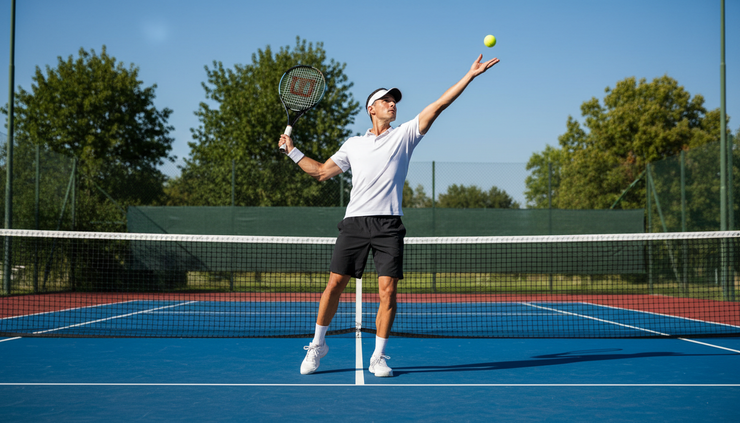
1. Relying too much on the arm
Many players try to create serve speed by swinging the arm harder. This often feels powerful, but it usually does the opposite. The shoulder and elbow end up doing work that should come from the ground, legs, hips, and trunk.
When the serve is arm-dominant, the kinetic chain breaks early. The lower body does not load properly, the trunk does not rotate with control, and the hitting arm rushes through the ball. This can reduce racket-head speed and make timing inconsistent.
It also increases injury risk. Repeated forceful serving with poor body contribution can irritate the shoulder, strain the elbow, and overload the wrist.
To fix it:
Start with a stable stance and relaxed grip.
Feel pressure build through the feet before the racket accelerates.
Let the legs drive upward as the trunk rotates.
Keep the hitting shoulder loose until the swing starts to accelerate.
A useful cue is: push from the ground, then throw upward. The arm should feel like the final whip, not the engine.
2. Poor knee bend and weak leg drive
A good knee bend is not a deep squat. It is a controlled loading position that allows the body to drive up into the ball. Some players barely bend the knees, while others collapse too low and lose balance.
If the knees stay straight, the serve loses upward force. The player may compensate by arching the back or overusing the shoulder. If the knees bend too much without control, the timing becomes slow and the upward drive disappears.
Poor leg drive affects performance in three ways:
Less upward momentum into contact
Lower contact point
Reduced power transfer through the hips and trunk
It can also stress the lower back, especially when the player tries to “find power” by leaning or twisting instead of driving up.
To correct it, aim for a knee bend that feels springy, not heavy. The knees should track in line with the feet. The weight should stay balanced rather than falling onto the heels or toes.
Practise this simple pattern without hitting:
Set up in your serve stance.
Toss and load smoothly through the knees.
Drive upward and freeze in a balanced trophy-to-contact motion.
If balance disappears, reduce the knee bend and focus on rhythm.

3. Opening the hips and shoulders too early
The serve needs separation between the hips and shoulders. This separation stores rotational energy, much like winding a spring. A common mistake is opening the hips, chest, and shoulders too early before the legs and trunk have transferred force.
When the front side flies open, the racket path often cuts across the ball. The result may be weak pace, reduced spin, poor placement, or a serve that pulls wide unintentionally. Early opening also makes the hitting shoulder chase the ball, which can place extra stress on the front of the shoulder.
From a Sports science point of view, this mistake disrupts sequencing. The body should transfer force from larger segments to smaller ones. Early rotation blurs that order and makes the arm work harder.
To improve sequencing:
Keep the tossing arm up slightly longer.
Let the hips begin the motion before the shoulders fully open.
Think of the chest rotating toward contact, not spinning away from the target.
Land with control, facing into the court.
A good cue is: stay side-on for a fraction longer. This helps the trunk rotate at the right time and gives the arm a better path to the ball.
4. Tossing the ball into the wrong contact zone
The toss controls the serve more than many players realise. Even with good mechanics, a poor toss forces the body into compensation.
A toss too far behind the head can cause excessive back arching and shoulder strain. A toss too far to the side may pull the body off balance. A toss too far forward can make the player chase the ball and collapse through contact.
The ideal contact zone depends on the serve type, but for a flat or slice serve, the ball should usually be slightly in front of the body and high enough to allow full extension. For a kick serve, the toss may sit a little more over the body, but it should not force a painful back bend.
Signs your toss is hurting your serve:
You fall sideways after contact.
You feel rushed before hitting.
Your contact point changes often.
Your lower back tightens after serving.
The fix is simple, but it needs repetition. Practise tosses without swinging. Let the ball drop and check where it lands. A consistent toss should land in roughly the same spot relative to your front foot.

5. Collapsing after contact instead of finishing with balance
The serve does not end at contact. The follow-through helps the body safely slow down the racket. When players stop the swing abruptly, fall away, or land off balance, the joints absorb more braking force.
A poor finish may show up as the racket stopping high, the body twisting sideways, or the player landing stiffly. This can reduce serve accuracy because the swing path changes at the last moment. It can also load the shoulder, elbow, lower back, and front knee.
A balanced finish shows that the body transferred force smoothly. The hitting arm continues across the body, the back leg may kick through naturally, and the player lands inside the court with control.
To build a safer finish:
Swing through the ball, not just to the ball.
Allow the racket to decelerate naturally across the body.
Land softly with the front knee slightly flexed.
Hold the finish for two seconds after each practice serve.
That final hold is a useful test. If you cannot pause after landing, the earlier parts of the serve may be out of sync.

A simple checklist for cleaner serve mechanics
Use this short checklist during practice:
Serve phase | What to check |
Setup | Feet balanced, grip relaxed, shoulders calm |
Load | Knees bend smoothly without collapsing |
Toss | Ball rises into a repeatable contact zone |
Rotation | Hips and trunk unwind in sequence |
Contact | Body extends upward, arm stays loose |
Finish | Racket follows through and landing is controlled |
Do not try to fix all five mistakes in one session. Pick one focus, film a few serves from the side and from behind, then compare what you feel with what you see. Video often reveals timing errors that are hard to notice in real time.
If a serve change causes sharp pain, stop and get guidance from a qualified coach, physiotherapist, or sports medicine professional. This article is for general information and should not replace personalised assessment.
The best serve improvements usually come from cleaner movement, not harder effort. Build force from the ground, keep the body sequenced, place the toss well, and finish in balance. Power becomes easier when the mechanics are doing their job.


Comments